Learn options — free
Plain-English lessons and free tools for people starting with stock options. Everything here is educational: it explains how strategies work and where they lose money, and never tells you what to buy or sell.
Lessons
- Calls and puts in 5 minutes
- Covered calls
- Cash-secured puts
- Credit spreads: capping the worst case
- Expected move and sigma bands
- Position sizing: the 1–2% rule
- Event risk, assignment and expiry day
- Seven common beginner mistakes
1. Calls and puts in 5 minutes
 ▶ Watch the 1-minute videoYouTube Short · in English
An option is a contract on 100 shares that expires on a set date.
- A call gives the buyer the right to buy 100 shares at the strike price until expiry. Buyers profit if the stock rises well above the strike.
- A put gives the buyer the right to sell 100 shares at the strike. Buyers profit if the stock falls well below it.
- The price of an option is the premium, quoted per share. A premium of $2.00 costs $200 per contract.
- Buyers can lose at most the premium. Sellers collect the premium but take on the obligation — and the risk — on the other side.
Example: a stock trades at $100. A one-month $105 call costs $1.50. The buyer pays $150. If the stock ends at $110, the call is worth $5 ($500): a $350 profit. If it ends below $105, the call expires worthless and the $150 is lost.
Premium has two parts: intrinsic value (how far the option is already in the money) and time value, which shrinks every day until expiry (called theta decay). Higher expected volatility (implied volatility) makes options more expensive.
2. Covered calls
 ▶ Watch the 1-minute videoYouTube Short · in English
You own 100 shares and sell one call against them. You keep the premium. If the stock ends above the strike, your shares are sold at the strike.
- Good for: earning extra income on shares you would be happy to sell at the strike.
- Upside is capped at the strike plus the premium.
- Downside is almost the same as owning the shares — the premium only cushions a fall slightly.
Example: you own 100 shares at $40 and sell a 2-week $45 call for $0.60, collecting $60. Stock at $43 on expiry: you keep the shares and the $60. Stock at $50: your shares are sold at $45 — you miss the move above $45.
Watch out: never sell a strike below the price you would accept for your shares. If the stock has fallen far below what you paid, a low strike can lock in a loss when it rebounds.
3. Cash-secured puts
 ▶ Watch the 1-minute videoYouTube Short · in English
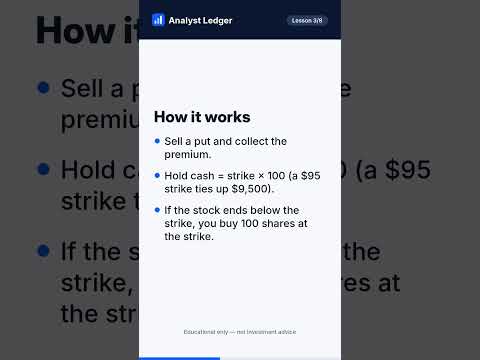
You sell a put and keep enough cash to buy 100 shares at the strike. You collect the premium. If the stock ends below the strike, you buy the shares at the strike.
- Good for: getting paid while waiting to buy a stock you want, at a lower price.
- Cash needed: strike × 100. A $50 strike ties up $5,000.
- Worst case: the stock collapses and you own 100 shares bought at the strike, far above market.
Example: a stock trades at $55. You sell a $50 put for $1.00 and collect $100, holding $5,000. If it ends at $52, you keep $100. If it ends at $40, you buy at $50: a paper loss of $1,000 minus the $100 premium.
4. Credit spreads: capping the worst case
 ▶ Watch the 1-minute videoYouTube Short · in English
A put credit spread sells one put and buys a cheaper put further below. The bought put limits the loss.
- Maximum loss = (distance between strikes − premium) × 100.
- Maximum gain = premium collected.
- Uses far less money than a cash-secured put, which is why small accounts use it.
Example: sell a $500 put and buy a $495 put for a net $1.20. Maximum gain $120. Maximum loss ($5 − $1.20) × 100 = $380 — more than three times the gain.
Watch out: spreads often win small amounts many times and then lose the maximum in one sharp fall. Size them so the maximum loss — not the expected gain — fits your rules.
5. Expected move and sigma bands
 ▶ Watch the 1-minute videoYouTube Short · in English
Options prices imply how far the market expects a stock might move. One standard deviation (1σ) of that move is roughly:
1σ move ≈ price × implied volatility × √(days ÷ 365)
Example: price $700, implied volatility 18%, 5 days → 700 × 0.18 × √(5/365) ≈ $14.7.
- In a textbook bell curve, the price stays inside ±1σ about 68% of the time and above −1σ about 84% of the time.
- Real markets have fat tails: very large drops happen far more often than the bell curve says. See our weekly backtest — SPY fell more than 3σ in a week about ten times as often as the bell curve predicts.
- A band is a description of what prices imply, not a forecast.
Try it with the expected-move calculator.
6. Position sizing: the 1–2% rule
 ▶ Watch the 1-minute videoYouTube Short · in English
Decide the most you will lose on one trade before you trade. Many traders use 1–2% of their account.
- With €5,000, 2% is €100. A spread whose maximum loss is $380 is too big for that account.
- Size by the worst case, never by the expected profit or the broker's "buying power".
- Avoid putting most of your account into one stock or one bet, even in different trades.
The budget planner works this out for you.
7. Event risk, assignment and expiry day
 ▶ Watch the 1-minute videoYouTube Short · in English
- Earnings, central-bank meetings, mergers and CEO changes can move a stock several sigma overnight. Many option sellers close positions before these dates.
- Assignment: a short option that is in the money can be exercised against you, usually at expiry and sometimes earlier (often before a dividend).
- Expiry day: a stock finishing close to your strike makes the outcome uncertain. Closing the position before the final hour avoids surprises.
- Gaps: stocks can open far from the previous close. A stop order does not protect you through a gap.
8. Seven common beginner mistakes
 ▶ Watch the 1-minute videoYouTube Short · in English
- Sizing by how much you hope to make instead of how much you could lose.
- Holding short options through earnings or major news.
- Buying cheap far-out-of-the-money options that almost always expire worthless.
- Using market orders on options with wide bid–ask spreads — always use limit orders.
- Doubling down on a losing bet to "win it back".
- Trusting high win rates without asking how big the losing trades were.
- Skipping a practice (paper) account and a written trading journal.
Start a trade journal — it is free and stays in your browser.
Educational information only — not investment advice. Options involve a high risk of loss and are not suitable for everyone. Analyst Ledger publishes factual records of publicly reported analyst rating and price-target changes for information only. Nothing here is investment advice or a recommendation to buy or sell any security. Data may be delayed or incomplete — always verify with the original source.
 Analyst Ledger